Let’s start from the beginning.
A guy whose content I follow religiously, Scott Dinsmore, explained in his famous Tedx Talk (4 million views on YouTube) the importance of setting ‘Physical Challenges’ for personal growth. His view was that if it’s a challenge/goal that you consider impossible for yourself, the pursuit of it pushes you to expand as a human being and opens up a world of possibilities once you achieve it.
As I’m very much interested in personal growth, I resolved to take this up as an experiment. I’ve been doing strength training since many years (on and off) but I hadn’t ever ran anything beyond 2kms. So running a Half Marathon seemed like a pretty impossible deal. And hence, it fit the profile. Immediately I registered in an upcoming Half Marathon.
There was just one catch. I had to run before the end of 2016 (for different OCD reasons) and the most appropriate marathon I could find was on December 11th. This means I was left with just 5 weeks to train, while ideally you should prepare for at least 12 weeks for a 21k.
I was compelled to find out a solution. (Note: Running a 21k is serious business. It’s a strenuous physical activity and attempting it without proper training might result in the runner fainting on the track before completing or even long lasting overuse injuries)
Well as they say, “where there’s a will, there’s a way”. Enter Tim Ferriss (find him on fourhourworkweek.com) and the concept of ‘Minimum Effective Dose’.
His famous adaptation of Pareto’s Law explains that in almost all contexts, 80% of the desired results occur as a result of just 20% of actions. Minimum Effective Dose is this 20% of actions that’ll make 80% of the difference. I just had to figure out these 20% of actions. (Given the scarcity of time I had to train)
After reading about 20 webpages, 2 chapters from a best-selling fitness book, and talking to 2 friends who are regular Ultra-marathon runners, I think I figured out my minimum effective dose. These are the things I focused on for the next 5 weeks.

- Nutrition: As a rule of thumb I increased my daily carb intake to facilitate my cardio sessions. Some specific changes that I made were eating a handful of cashews and almonds first thing every morning, multi vitamin capsules once every day, 2 bananas or 2 peanut butter sandwiches on long run days. The key was to remain properly hydrated, 2-3 litres a day. (A DIY yardstick for measuring hydration levels is to check urine colour, details available online)
- Sleep: A very less appreciated fact about sleep is that its most important function is to repair and recover the body (and the brain). Hence sleep quality cannot be overlooked. Apart from sleeping on time every day for a minimum of 6.5 hours, I also downloaded an app called Flux (available on getflux.com). It removes Blue light from your phone and laptop screens. Staring at bright blue lights a few hours before sleeping inhibits the production of melatonin, a hormone critical for sleep quality. Simply speaking, Blue Light at night equals screwed up sleep.
- Work-Out: As an amateur I used to think that to prepare for a marathon I’ll have to run every day. But very soon my research showed that the most important aspect of marathon training was RECOVERY and STAYING AWAY FROM INJURIES. With a lot of help from a friend, I created this training regimen. In each week I’d do – 1 Long Run Day, 3 Days of HIIT, 1 Day of Breathing Exercises, 2 Days of Rest (So many rest days because training with a full time job adds strain to the body). Yes, you read it right. For completing a 21k, my training consisted of only 5 ‘run’ days in 5 weeks. On these ‘Long Run Days’ I’d push my body to the limits and increase my distance at moderate pace. {6k – 10k – 11k – 13k – 15k; this is what I ran on those 5 days}. Again, the key thing was Recovery and Staying Away From Injuries.
- Body Form & Posture: I learned very soon that running a marathon is a game of conserving energy on race day. Apart from the common suggestions of maintaining a regular pace, starting slow etc. I found that people expend their most energy due to ‘bad posture’. The correct way to run, I found, is with your back straight, chest out, shoulders pulled back and relaxed, eyes staring at a distant point far ahead, equal weight on both the glutes (grounded), arms at 90 degree angles, very short strides so that frequency of strides increases and energy expended decreases, and hitting the ground very ‘lightly’ with your feet (because the ground hits back). I added one practice of my own in this mix. I found that keeping a ‘Poker Face’ throughout the run helps you remain calm and hence conserve even more energy.
- Breathing: Since what I was going to attempt (training for a 21k in 5 weeks) was not recommended on any of the webpages I had read, it was a first. And I had to take a ‘leap of faith’ to survive this experience. The premise I decided to move ahead with was “My body can take the strain, my job is just to not lose my breath”. So while running, no matter how difficult it was, I had to follow these rules. To breathe only through my nose, to breathe smoothly and calmly (minimal sound created), and to breathe coherently (maintain a consistent ration i.e. 4in-4out or 3in-3out).
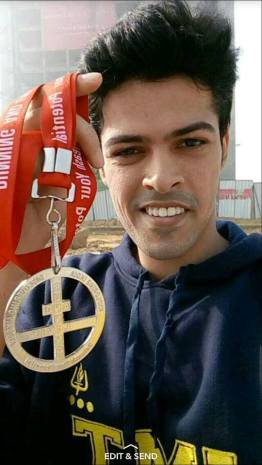
December 11th came and went. And how I related to myself changed forever. A person who could not even run 2kms without getting exhausted, completed a course of 21kms, with no injuries and a smiling face.
Right now, as I’m writing this post, my body is recovering from the run but my mind is set free.
For all intents and purposes, a new question has arisen “If this was possible, what else can be?”

 inventedlifeblog