To ‘Ship’

Here’s an idea.

Is it better to continually improve upon the quality of your production, and ship the product when & only when it’s become the best work of yours?

Or is it better to have stringent timelines & ship the product when the due date has arrived, whether or not “you think” it’s ready to be shipped or not?

In this world of information & choice overload, who wins? The one who has the best offering? Or the one who has a huge string of good enough offerings out there in the market?

Elizabeth Gilbert, best selling author of Eat Pray Love says “Done is better than Good”.

*In a product related company’s context, ‘to ship’ means to introduce/launch your product in the market.

*In a creative context, it means to share your ideas with an audience. It may mean posting your blog/article, whether or not you think it’s a perfect encapsulation of your ideas or not.


Is it not that having a ‘shipping’ mentality is a matter of discipline?

For some reason, people tend to think that if they commit to a set timeline they’d end up compromising on quality. But is it not a common aspect of human behaviour to delay taking action using whatever justification is available? Can this weird obsession of bringing quality be just another action-delaying-mechanism?

As I write this, I’m struggling myself to find the answer to the above questions. I invite the reader to take a minute and ponder on this thought herself, to put it in context of her own situation, and come up with her own answer.

Is done really better than good?

Mindful New Year’s Resolutions

It is the last week of December 2017 and as I begin to write this post I can’t help but think about the approaching end of the year. That amazing time which propels almost all of us to think about making a fresh start. At this time of the year it’s not uncommon for people to think about what they wish to achieve next, hence the invention of this thing called ‘New Year’s Resolutions’.

I think NYRs are awesome. It’s a ritual that helps us to stop, step back from our daily grind, evaluate what’s going on in our lives and hopefully dream up a better vision of what we want to happen in the times to come. It is perhaps an exercise that one should do much more often.

Nonetheless, better once a year than never.

However, every time I am thinking of such kind of resolutions, I’m firstly reminded of what had happened in the recent past. Come to think of it, we just completed living another glorious year of our lives. 2017 was not just made up of 12 months or 365 days, it was filled with countless of memories, experiences, challenges, breakdowns, breakthroughs, ups & downs and perhaps some life altering events. And I don’t find any authenticity in any New Year Resolution if it doesn’t derive from an appreciation of what I had gone through the whole past year.

Which is why I am taking up to do a ‘Post-Game Analysis’ on the year that just went by. A reflection that is meant to bring to my attention all the things that went well, and help me articulate learnings from all that didn’t go so well.

And in line with the Christmas spirit, I wish to share with you my thoughts on this nice little ritual. After some quick research I have come across some nice ideas as to how I can evaluate the past year and I’m going to mention here the ones that most caught my attention. While I am going to go through all of the following {tools}, you are not at all required to do the same. This is no step-by-step guide on ‘How to do New Year Resolutions’, rather it’s just a gift basket from a friend. Take what you like, add a couple of your own items if you’re moved to.

So here we go…

  1. List out all the ‘Firsts’ of 2017

This means all the kind of experiences you had for the first time in this year. It could be as small or as big as you’d like. I’m sure some of the items on the list will bring a smile to your face.

  1. Do an 80-20 analysis

If you’re familiar with Pareto’s Law, you would know it generalizes that in almost all contexts, 80% of the outcomes are derived from 20% of the causes. So here, ask yourself two questions:

  • What were a few key activities / experiences / people that led to the majority of my positive emotions in the previous year? (and list them out)
  • What were a few key activities / experiences / people that contributed greatly to most of my negative emotions? (list these out too)

Your purpose of doing this exercise would be to know exactly what has been working for you, and what against you. And hopefully increase the former while eliminating the latter as much as possible.

  1. Ask five of your closest people; “In 2018…
  • What should I do more of?
  • What should I try to eliminate from my life?

You see, the people closest to you can see more about you than you can. They know your unique strengths & weaknesses and know exactly where you deserve to be in life. But sometimes we do not honour our own calling. Trust me, having a loved one remind your calling to you could be the biggest motivator for you to take the required actions. So there…

  1. If you are into any kind of journal writing habit, then take out a couple of hours and read all that you wrote in those journals in the last 12 months. I bet you’d be pleasantly surprised. This would even shed light on what specific things you have to put more focus on, in the year to come.
  2. You can even cook up your own questions. Questions are a great way of shedding light on your experiences. Some interesting questions I came across were: (stacked in the order of depth of meaning)
  • Exactly how much money did I make in the past year? How much of it did I save/invest?
  • Any major health related setbacks? What in my body deserves more attention in 2018?
  • How has this year added to my life? What new skills, insights have I got?
  • What has this previous year put me on a path of? Is this a path that I like? Any course correction needed?

I do believe that pondering on these questions can provide tremendous amount of insights into what we want & don’t want. This exercise is not only meant to enlist all that happened, but also to evoke a yearning for what didn’t happen. Or what went missing. Because from that space, we can emerge and create some really meaningful resolutions.

Now let’s come to the actual goal-setting part. I totally get if you have some really BIG goals/resolutions lined up in your mind. I have those too. I have things that I want to accomplish with regards to my body, my relationships, finances, career, intellect etc. The whole shebang.

However, I also came across a very new & refreshing line of thinking to come up with resolutions. This line of thinking is also in the form of a question. This comes from a female entrepreneur (a very successful one), who during her brainstorming sessions asks her staff – “Hey, wouldn’t it be cool if ____________?”

And she lets them fill in the blank. She’s reported that out of such sessions her team has come up with some of the most interesting, wackiest, admirable, bold and enticing ideas. Some that were even at the bedrock of the strategy her company has formulated.

So go ahead, ask yourself “Wouldn’t it be cool if ______________?”

When I asked this question of myself, a voice inside said “Ofcourse I’m committed towards my money goals, career goals etc. etc. but it would be really cool if I could learn to do a handstand this year”. I don’t think doing a handstand would any-which-way add to my bank balance or anything, but it would mean a whole new experience of being ‘me’. And I want that for me.

Maybe you’d come up with something entirely different. Who knows!

***

It’s not wrong to say that life is the sum total of all your experiences. So maybe the access to improving life is through improving day-to-day experience. And I have a belief that we have much more influence over our experience than we think.

So take out your pen & diary or your note taking devices (for the tech-savvy yous) and begin crafting a pleasurable & extraordinary experience for yourself.

Love.

Merry Christmas.

And a Happy New Year.

When I went on a total social media fast…

So, back in 2016 I began experiencing a couple of things. Though they might’ve been unrelated but they seemed to make sense when put together in perspective.

I was at a job that I didn’t like very much. I had plans to quit that job and start something of my own, but those plans weren’t very structured and hence I was mostly slightly anxious and in a second-guessing mode.

At the same time I had been stumbling upon article after article, talk after talk; that were somewhat talking about the adverse effects of overexposure of social media on our lives. This repeated stumbling might have been by the virtue of search history, browser cookies and other pattern recognition software, but at that time I interpreted this as some cosmic hint. Like someone was watching over me, and wanted to give me a way out from my usual tense days.

But before moving forward let me elaborate what these talks and articles said. There were many perspectives. Some said that we are so much consumed in the internet world that we miss out on the real world. So much so that, even when we are physically present with someone we can’t totally be present with them, and instead have this impulse to go back to our ever elusive ‘news feeds’.

Some said that for most people, staying on social media is not a productive activity as they’re mostly just consuming information instead of creating something or utilizing that information for some productive use. And since everyone has just 24 hours in a day (actually much less if you remove time spent on sleeping, eating, commuting, day-dreaming etc.) social media has become a very substantial distraction in our lives, thus blocking us from spending time on really productive activities. This point was critical for me because I didn’t care if I lost a little bit of productive time during my day job. But I had made a promise to myself that everyday after coming back home I will devote some hours towards finding out a career option that I am passionate about. And this endevour was surely being sidetracked due to many distractions, social media indulgence being one of them.

Some articles in scientific journals said that there were conducted some fMRI studies to test the effects of social media on a person’s brain. And these tests found out that a person’s brain when on social media acts a lot like a person’s brain while taking hyper-addictive drugs like cocaine. This was a shocker to me. They found out that the reason for cocaine being so addictive is that it instantly prompts the secretion of a neurotransmitter (hormone) in the brain that makes the person feel immense pleasure and thus provides positive motivation to keep repeating that behavior i.e. taking more cocaine. They found out that whenever we receive a like or comment on one of our post, or especially as we’re scrolling down our news feed, a similar secretion of dopamine takes place in our brain. And thus we get that tiny shot of pleasure. This keeps us scrolling down further and further until something else breaks our trance like state.

These few perspectives that I found were impactful but not truly compelling. Until one fine day…

One day I woke up and was laying in my bed for some extra minutes of comfort. I was thinking of what all I had to do that day. Go to that place, do that thing, talk to that person etc. And suddenly, like a brick to my face, it hit me. I realized that every morning I wake up, from the exact moment that I open my eyes, a to-do list also wakes up with me.

A little voice inside me that somehow remains ready to bombard me with tons of information about “what I have to do, what I don’t want to do, what I could have done better yesterday, how that should have happened, how this would happen, what if I did this, why have I not been able to do that.. on and on and on.”
It keeps on talking and talking and mostly it’s not something that is very pleasant to hear.

I was utterly shocked by this realization because I also realized that how consumed I am in my own thought processes the whole day. It was as if my whole existence revolved around these things I wanted to do, have and be. It was a truly transformational moment for me because I could step back and observe my thoughts from a ‘hawk eye’ perspective. And I didn’t like what I saw. I wondered “is this why I am here? to finish a few silly tasks? and obsessing about them day-in and day-out?”

I didn’t like my reality even one bit. And that was when I was reminded about another perspective I had heard about social media. (Well, to be honest, it wasn’t entirely about social media but a much larger contemplation). This perspective said that we’re often so much domesticated in our daily grind, hundreds of times doing the same things over and over, that it becomes almost normal for us to spend the entirety of our days on auto-pilot mode. We are awake but never truly present. We are responsive but never truly appreciative or at ease. We spend most of hour waking hours in a zombie like state, not unhappy, but utterly powerless to create any substantial change in our lives or in the world around us. If we want to create such change, it would demand for us to come to our senses, take a step back, and look at our minute-to-minute existence from a ‘hawk eye’ view. And evaluate if it is going how we want it to go? And if not, what is my say in the matter?

I know this post suddenly went too metaphysical & esoteric but this is how I was feeling in that moment.
So I decided to make a drastic change in my life. I decided to go on a total social media fast for exactly one month. And at the end of this one month I would look back and evaluate if this change had impacted my life positively. It was a kind of test I was doing. And I was charged up thinking about what I would find at the end of the road.

[Note: I knew at that time that social media indulgence wasn’t a primary cause to my problems, but it wasn’t helping either. So I decided to eliminate just this one bit from the whole equation to see what effects this had. This is a standard way of testing a hypothesis by the way]

So this social media fast had three aspects.
1. I deleted all of the social media apps from my phone. (At the time I was using only Facebook, Instagram & Snapchat)

2. I decided that I cannot even touch my smartphone within 30 minutes of waking up, and 30 minutes before going to sleep at night

3. Since I had my first 30 minutes of the day intentionally cleaned free, I would take that time each day to go for a walk & think about what I was grateful for

***

What happened over the next couple of weeks is hard for me to put in words. It was a weird kind of cascade of positive events. And it was pretty evident from the start that I had found something really beneficial by taking this up.

So let me try to profile all the benefits I started experiencing.

Firstly, since there was no Insta or Snapchat, suddenly there was no more a mandate for me to click a picture of every funny/stupid/interesting thing I saw & post it online. Nor was I required to be updated about what the rest of the world was doing. I experienced a weird sense of calmness from this.
I say weird because it was like one of those stories. Stories where the hero had been born with a weight on his shoulders and had spent his entire life like that. It’s only when that weight is taken off that he realizes what life could be like without that weight. It’s a new kind of experience and that’s why I’m calling it a weird calmness. I don’t know if everyone is in the same predicament as I was. But I don’t think you can find that out unless you lift off that weight from your shoulders.

Secondly, refraining from checking my phone first thing in the morning (& last thing at night) was a massive pattern interrupt for me. During the first few days it instantly gave me some meditative effects. This is how it used to look. I would wake by the sound of my alarm. As a habitual instinct my first act of the day would be to pick up my phone & open the lock. But I suddenly would get reminded that “Hey, I can’t do that”, and I would keep my phone down.
THEN, I would take a moment and suddenly realize that I’m in a room. It’s my room so no surprises there, but I actually would look around. Notice the colors of the walls, our bed sheets. I’d notice the bright warm sunlight pouring in from the window and experience the richness of the morning sky outside. It won’t take long for my attention to go to the birds chirping outside, or the traffic moving down the roads below. I would take all these sensory inputs & cozy up a little in my comfortable bed. Feeling & experiencing the impact of my blanked on every part of my body. Fully aware and fully in the present moment. This experience of merely 5 minutes started to become that part of my day that I most looked forward to. I started to be excited about getting up in the morning. Nothing like this had ever happened for so many days in a row. I knew I was on to something.

Thirdly, I found out that all that morning laziness I felt while in the bed, totally vanishes the moment I get out of it and start walking. It was something that you always know intellectually but still is remarkable when you experience it firsthand. So I noticed that as soon as I started walking not only my body went from a sleepy state to an awake and heightened state. Even my mind became hyper excited & charged up. But in this instance it would go towards only positive, resourceful and empowering places. While walking every morning I used to naturally have thoughts like “what all can go right today, how is today’s meeting an opportunity, what’s a hidden benefit that I’m not able to see yet in a problem I’m facing etc.”
So I found out that just by changing my physical state I could impact my mental or emotional state. It even resonated with a quote I had heard from Tony Robbins that said “Motion creates Emotion”. All of this was positive, but each day I also remembered my initial promise. That I will walk and contemplate all the things I am grateful for. So each morning, while my mind was running towards a 100 different (& positive) directions, I would catch its reins and bring it to this question “what am I grateful for right now?”.
I would ask this question to myself and mostly each time was provided with an answer from the inside. Then I asked the question again “what else am I also grateful for?”. And then a new answer would come.
I kept repeating till as long as I wanted. And this was so much fun! Shots of empowerment within the first 60 minutes of the day. Who wouldn’t want that.

In fact, I even started experiencing a positive side effect of this exercise. You see, each time I would ask myself the gratitude question, my mind would sooner or later wander away into some unrelated thoughts. That’s the common behavior of our mind. It invariably goes into multiple trains of thoughts without much of our will. But almost everyday, after 2-3 minutes of my mind wandering, I would suddenly realize “hey I was asking my mind a question”. So I would bring my mind back. This used to happen at least 5-6 times during a 20 minute walk. I would ask myself a question. The answer would come from the inside. In between somewhere, the mind would wander away. Then I would realize that it has wandered away and I would bring it back.

A few days later I started noticing that my ability to remain focused had increased substantially. At least by a factor of 5. I could maintain laser sharp focus on anything I was doing, throughout the day. It was enough of a difference that I could notice it very clearly. I was suddenly able to remember the conversations I had had with people hours ago, exactly verbatim i.e. word by word as it had happened.

A few months later I found out that what I had been doing as part of my morning rituals is the classic way to practice mindfulness meditation. You focus your attention on a singular aspect of experience. And whenever your mind wanders away, simply notice that it has wandered away, and gently bring it back to the same thing you were concentrating on earlier. Attention & Focus are like muscles, you can make them stronger by working them out over a consistent time period. And unknowingly I was doing the same thing. Well good for me!

***

I did these things (social media fast) and experienced so many delightful benefits in such a short time that I was sure that I would continue this for the rest of my life.

When the one month was over. I looked back at the 30 days that had passed by. I was sure that my tendency to over-indulge in social media had gone away, because now it made no difference to me if I used social media in the future or not. I was much more in control of my daily moods & emotions and very rarely allowed any distractions to come between me and my plan for the day. And most importantly, my overall stress and second-guessing nature had been much calmed down over those 30 days. So I was able to accomplish more, with a lot less of fussing over it.

Now many months have passed since I had this experience. And today I am on social media as any other normal person. But I think now I control my phone instead of the other way around.

And as for my other rituals i.e. not looking at phone screens first & last thing in a day; and going for morning walks & gratitude.. I still continue those things to this day.

Over the last few months I have accomplished some very notable things in my life. And I am certain that they have been possible because of my ability to stay ‘present’ and take daily decisions proactively rather than reactively.

Hope this helps!

List of Books I’ve Read Till Date (October 2025)

IMG_7626

Here’s the list. Almost in chronological order.

  1. iCon: Steve Jobs – Biography
  2. Losing My Virginity – Autobiography of Sir Richard Branson
  3. Stay Hungry Stay Foolish – Rashmi Bansal
  4. Rich Dad Poor Dad – Robert Kiyosaki
  5. Rich Dad Quadrant – Robert Kiyosaki
  6. Richest Man in Babylon – Samuel Clason
  7. The Intelligent Investor – Benjamin Graham
  8. Think and Grow Rich – Napoleon Hill
  9. Harry Potter (the entire series) – JK Rowling
  10. The Great Gatsby – F. Scott Fitzgerald
  11. The Catcher in the Rye – JD Salinger
  12. The Da Vinci Code – Dan Brown
  13. Angels & Demons – Dan Brown
  14. Digital Fortress – Dan Brown
  15. Social Intelligence – Daniel Goleman
  16. Mind Over Medicine – Lissa Rankin
  17. Awaken The Giant Within – Tony Robbins
  18. As A Man Thinketh – James Allen
  19. Strengths Finder 2.0 – Tom Rath, Gallup Inc.
  20. The Monk Who Sold His Ferrari – Robin Sharma
  21. The Pathfinder – Nicholas Lore
  22. The Four Hour Work Week – Tim Ferriss
  23. Money: Master The Game – Tony Robbins
  24. The Philosophy Book – Will Buckingham, DK Publishing
  25. Neurologic – Eliezer Sternberg
  26. Frogs Into Princes – Richard Bandler
  27. NLP: The new technology of achievement – Steve Andreas & NLP Comprehensive
  28. The Structure of Magic 1 – Richard Bandler
  29. Positive Intelligence – Shirzad Chamine
  30. How to Fail at almost everything and still Win Big – Scott Adams
  31. The Six Figure Speaker – Brian Tracy
  32. The Four Hour Body – Tim Ferriss (work in progress)
  33. The Effective Executive – Peter F. Drucker (work in progress)
  34. Stealing Fire – Steven Kotler & Jamie Wheal
  35. Big Magic – Elizabeth Gilbert
  36. Anything You Want – Derek Sivers
  37. The Obstacle Is The Way – Ryan Holiday
  38. Siddhartha – Hermann Hesse
  39. Unlimited Power – Tony Robbins
  40. Thinking, Fast and Slow – Daniel Kahneman (work in progress)
  41. The Subtle Art of Not Giving a F*ck – Mark Manson
  42. The World’s Fittest Book – Ross Edgley
  43. Don’t say Yes when you want to say No – Herbert Fensterheim Ph.D
  44. Own the Day Own your Life – Aubrey Marcus
  45. 48 Laws of Power – Robert Greene
  46. Linchpin – Seth Godin
  47. 12 Rules for Life – Jordan Peterson (work in progress)
  48. Never Eat Alone – Keith Ferrazzi
  49. Wheat Belly – Dr. William Davis
  50. The Way of the Superior Man – David Deida
  51. The Game – Neil Strauss
  52. The Imposter Syndrome Remedy – Dr. EV Estacio, Ph.D.
  53. Atomic Habits – James Clear
  54. The 5 AM Club – Robin Sharma
  55. Vagabonding – Rolf Potts
  56. The War of Art – Steven Pressfield
  57. The Millionaire Fastlane – M.J. DeMarco
  58. The Million-Dollar, One Person Business – Elaine Pofeldt
  59. 40 Rules of Love – Elif Shafak (work in progress)
  60. Total Recall – Autobiography of Arnold Schwarzenegger (work in progress)
  61. Never Split the Difference – Chris Voss (work in progress)
  62. Getting Things Done – David Allen
  63. Men, Women & Worthiness – Brene Brown
  64. I thought it was just me, but it isn’t – Brene Brown
  65. Designing your life – Bill Burnett & Dave Evans
  66. The Rational Male – Rollo Tomassi
  67. Focus – Heidi Grant Ph.D. and Tory Higgins Ph.D.
  68. The Easy Way to Stop Smoking – Alan Carr
  69. Sapiens – Yuval Noah Harari
  70. Personality & its Transformations – Lecture series by Jordan Peterson
  71. Maps of Meaning – Lecture series by Jordan Peterson
  72. The One Thing – Gary Keller & Jay Papasan
  73. The Little Book of Happiness – Miriam Akhtar MAPP
  74. Four Thousand Weeks – Oliver Burkeman
  75. The Little Prince – Antoine De Saint Exupery
  76. Digital Fortress – Dan Brown
  77. Meditations – Marcus Aurelius
  78. $100 Million Offers – Alex Hormozi
  79. Mastery – Robert Greene
  80. The Dip – Seth Godin
  81. Beyond Order – Jordan Peterson
  82. Codependent No More – Melody Beattie
  83. The Gifts of Imperfection – Brene Brown
  84. Bird by Bird – Anne Lamott

Basics of public speaking from a Toastmaster

It was a year ago that I discovered that I have a natural inclination to speak to (or in front of) people and that I am better at it than most of the other things I do. Since the time I found this strength of mine, I’ve dedicated countless of hours to nurture this talent and hopefully have come a long way.

I do this because it is one thing to be talented at something, and that can take you far in life. But it is entirely another thing to work hard in that talent and make it a skill. A skill is something that you’ve cultivated, and not just inherited. It’s something that you can keep perfecting with practice. It’s something that you can put to competition with the rest of the people who’re also talented. It is this skill that will surely take you to the highest levels of your chosen endeavour.

Like any other skill, you can learn a great deal by just observing ‘the best’ players in that game. And if you observe with enough attention and curiosity, your brain models the behaviour of these people and automatically begins to mimic it in your own behaviour.

For this purpose, I began listening to more and more speakers. (Though I already used to listen to a lot many talks)

I watched numerous TED Talks, Debates, Conferences, Interviews, Presentations, Motivational Speeches, Keynote Speeches, and even famous scenes by some very well renowned actors. I wanted to expose my brain to as much speaking as possible, so that it could unconsciously pick up styles and strengths of these great speakers. Some people that I ended up following (and I think you should too) are Werner Erhard, Tony Robbins, Tim Ferriss, Russell Brand, Sam Harris, Scott Dinsmore, Sir Ken Robinson, Tom Bilyeu and Marie Forleo also has become my recent favourite. And then there are speeches by Shashi Tharoor and Prime Minister Narendra Modi that I couldn’t admire enough.

So for anyone who’s looking to learn public speaking, my first suggestion would be to watch, immerse in and admire a lot of good speeches. And let your curiosity do the rest of the thing. Doing just this exercise would put you in a much better space than you’d be in without it.

Considering you’ve come this far, I want to come to the second step, that is action. Or should I say, practicing what you’ve observed.

My mode of choice was to join Toastmasters International, that is a global organisation, which has structures for developing people in communication and leadership capabilities. How it works is that you join any local Toastmasters club, which is essentially a group of people who come together once every week and hold a meeting where people either deliver speeches or work in various leadership capacities. Once you’ve joined such a club, you too get to deliver speeches and work in various leadership capacities.

Let me elaborate Toastmasters structure for developing people in public speaking. Each member is given a communication manual that has 10 speech projects. Every project deals with one specific skill that a public speaker must possess. So as a member, you have to deliver these 10 speeches, while working on and demonstrating the specific skill your current speech project deals with.

Let me explain this with an example. One of the speech projects is about ‘body language’. So while delivering this speech project, you have to specifically work on various body language skills and weave some of these skills into your speech. One key body language skill is the use of hand gestures. So while preparing for and delivering this speech you have to carefully integrate the use of hand gestures throughout the speech. Once you’ve done this, you instantly add one tool to your ‘public speaker toolkit’. And with enough practice of this tool, you can begin to utilize as and when you desire. And each tool you add to your toolkit, adds to your effectiveness and grace as a public speaker.

There are 10 speech projects in the first communication manual you get after joining toastmasters (including the project about body language). After you’ve completed these 10 speech projects, you proceed to other sets of manuals which deal with certain advanced aspects of public speaking.

Today as I’m writing this, I know that completing those 10 speech projects have added immense value to me as a speaker. Among others, one key benefit is that you get a checklist of the things you have to integrate in a speech you’re creating or preparing for. I will mention some of these checklist items (that I got from those 10 speech projects) that I always consider while preparing for a speech.

  • Objective of the speech (what’s the general purpose and specific purpose, what outcome do I want after having given this speech)
  • Structure of the speech (planning an impactful opening and closing. Keeping the body of the speech engaging; attention span of the audience is like that of 3 year old’s. Is it chronological in nature, a problem-solution piece, anecdote, or an abstract unstructured one)
  • What literary devices can I add? (simile, metaphors, repetition, other rhetoric devices)
  • Body language (how can I add the use of stance, movement on stage, hand gestures, facial expression to better communicate my message)
  • Vocal variety (where can I employ variation in my voice’s pitch, volume, speaking rate and tonality)
  • Research (is there any research needed. Can I add some statistics, facts etc. to validate my point)
  • Visual or auditory aids (do I need to add any visual aids like PPT or props, or auditory aids like music playing in the background)


All of this might seem overwhelming but really is not. That is because of two reasons. One is that while practicing these speech projects, you deal with one specific skill at a time. So you can really isolate it and focus on just that skill instead of a 100 other things. The other reason is that in a very short while you begin to incorporate all the above aspects intuitively and don’t have to consciously think about them too much.

All the above things I’ve written deal with the question “how do I become a good speaker”. But now I want to deal with the more important question, “what do I speak about”.

I want to introduce you all to Dale Carnegie here. He was a visionary writer and lecturer who lived through late 80’s to mid-90’s. Much of Dale’s ground-breaking work has been in the subjects of self-improvement and he has been like a founding father throughout the public speaking movement.

He advised to young speakers that “if you want to be a great public speaker, speak about something that makes you angry about the world” (not verbatim).

This basically means that if you look inside, find out something that you really care about, and then speak around that topic or subject, you instantly infuse your speech with most of the necessary components of a great speech i.e. authenticity, reliability, credibility, passion, drive, emotion etc. Your speech moves from an informative announcement to a heartfelt story. This, I believe is at the heart of all speaking. Because the purpose of all good speakers is to make some change in their audience, or the whole society. And if you find that one thing that makes you angry about the state of this world, you have taken a quantum leap as a public speaker, almost instantly.

And do not worry if you can’t find something that maddens you or you’re not that kind of person that gets angry at stuff. I’m sure if you ask yourself this question you can find that thing for yourself, this question is “what thing in the world I would absolutely change, if I had all the time, money, capability and resources with me?”

All of us have an answer to that question buried deep inside our hearts. Do yourself a favour and ask yourself this question. YOU can thank me later.

FINALLY, I want to leave you with one perspective. I often get disturbed when people utter the words Public Speaking. I get disturbed because everyone believes that when you are on the stage it’s all about speaking, hence the name ‘Public Speaking’, but giving a great and effective presentation is much more about Listening than it is about Speaking. Someone who’s on the stage is constantly listening to his audience. The words the audience is using during interactions, their eye movements, their body posture, the overall mood and energy of the room, all of these are feedback for the speaker. And for a speaker to be really effective he has to constantly remain in this feedback loop. Otherwise it’s just like reading out from a piece of paper, which is boring, monotonous and ineffective. So I’d like to replace the title Public Speaker with Public Communicator.

Because it is in the act of ‘Communicating’ that the true magic of Public Speaking reveals itself.

How I completed a Half Marathon with just 5 weeks of training {and no injuries :)}

running-and-living-5

Let’s start from the beginning.

A guy whose content I follow religiously, Scott Dinsmore, explained in his famous Tedx Talk (4 million views on YouTube) the importance of setting ‘Physical Challenges’ for personal growth. His view was that if it’s a challenge/goal that you consider impossible for yourself, the pursuit of it pushes you to expand as a human being and opens up a world of possibilities once you achieve it.

As I’m very much interested in personal growth, I resolved to take this up as an experiment. I’ve been doing strength training since many years (on and off) but I hadn’t ever ran anything beyond 2kms. So running a Half Marathon seemed like a pretty impossible deal. And hence, it fit the profile. Immediately I registered in an upcoming Half Marathon.

There was just one catch. I had to run before the end of 2016 (for different OCD reasons) and the most appropriate marathon I could find was on December 11th. This means I was left with just 5 weeks to train, while ideally you should prepare for at least 12 weeks for a 21k.

I was compelled to find out a solution. (Note: Running a 21k is serious business. It’s a strenuous physical activity and attempting it without proper training might result in the runner fainting on the track before completing or even long lasting overuse injuries)

Well as they say, “where there’s a will, there’s a way”. Enter Tim Ferriss (find him on fourhourworkweek.com) and the concept of ‘Minimum Effective Dose’.

His famous adaptation of Pareto’s Law explains that in almost all contexts, 80% of the desired results occur as a result of just 20% of actions. Minimum Effective Dose is this 20% of actions that’ll make 80% of the difference. I just had to figure out these 20% of actions. (Given the scarcity of time I had to train)

After reading about 20 webpages, 2 chapters from a best-selling fitness book, and talking to 2 friends who are regular Ultra-marathon runners, I think I figured out my minimum effective dose. These are the things I focused on for the next 5 weeks.

running-and-living-4

  1. Nutrition: As a rule of thumb I increased my daily carb intake to facilitate my cardio sessions. Some specific changes that I made were eating a handful of cashews and almonds first thing every morning, multi vitamin capsules once every day, 2 bananas or 2 peanut butter sandwiches on long run days. The key was to remain properly hydrated, 2-3 litres a day. (A DIY yardstick for measuring hydration levels is to check urine colour, details available online)
  2. Sleep: A very less appreciated fact about sleep is that its most important function is to repair and recover the body (and the brain). Hence sleep quality cannot be overlooked. Apart from sleeping on time every day for a minimum of 6.5 hours, I also downloaded an app called Flux (available on getflux.com). It removes Blue light from your phone and laptop screens. Staring at bright blue lights a few hours before sleeping inhibits the production of melatonin, a hormone critical for sleep quality. Simply speaking, Blue Light at night equals screwed up sleep.
  3. Work-Out: As an amateur I used to think that to prepare for a marathon I’ll have to run every day. But very soon my research showed that the most important aspect of marathon training was RECOVERY and STAYING AWAY FROM INJURIES. With a lot of help from a friend, I created this training regimen. In each week I’d do – 1 Long Run Day, 3 Days of HIIT, 1 Day of Breathing Exercises, 2 Days of Rest (So many rest days because training with a full time job adds strain to the body). Yes, you read it right. For completing a 21k, my training consisted of only 5 ‘run’ days in 5 weeks. On these ‘Long Run Days’ I’d push my body to the limits and increase my distance at moderate pace. {6k – 10k – 11k – 13k – 15k; this is what I ran on those 5 days}. Again, the key thing was Recovery and Staying Away From Injuries.
  4. Body Form & Posture: I learned very soon that running a marathon is a game of conserving energy on race day. Apart from the common suggestions of maintaining a regular pace, starting slow etc. I found that people expend their most energy due to ‘bad posture’. The correct way to run, I found, is with your back straight, chest out, shoulders pulled back and relaxed, eyes staring at a distant point far ahead, equal weight on both the glutes (grounded), arms at 90 degree angles, very short strides so that frequency of strides increases and energy expended decreases, and hitting the ground very ‘lightly’ with your feet (because the ground hits back). I added one practice of my own in this mix. I found that keeping a ‘Poker Face’ throughout the run helps you remain calm and hence conserve even more energy.
  5. Breathing: Since what I was going to attempt (training for a 21k in 5 weeks) was not recommended on any of the webpages I had read, it was a first. And I had to take a ‘leap of faith’ to survive this experience. The premise I decided to move ahead with was “My body can take the strain, my job is just to not lose my breath”. So while running, no matter how difficult it was, I had to follow these rules. To breathe only through my nose, to breathe smoothly and calmly (minimal sound created), and to breathe coherently (maintain a consistent ration i.e. 4in-4out or 3in-3out).

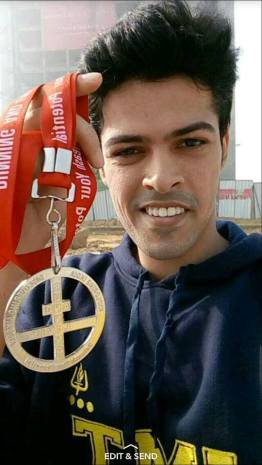
December 11th came and went. And how I related to myself changed forever. A person who could not even run 2kms without getting exhausted, completed a course of 21kms, with no injuries and a smiling face.

Right now, as I’m writing this post, my body is recovering from the run but my mind is set free.

For all intents and purposes, a new question has arisen “If this was possible, what else can be?”

running-and-living-2

Of Life and Purpose…

The best I know to describe life is, that it has a drift.

It’s very much like a stream of water moving in a particular direction. And all people (most of them unknowingly) keep drifting along in that stream. So for most people the direction of their lives is driven by whatever circumstances show up. Which is, by the way, very much valid. I KNOW that circumstances can be tough.. Very tough… But there is a very clear distinction in knowing that they are not chosen by us. We’re given our circumstances. And most people never have any say about their life.

They have a wish for their life. And for sure, this wish doesn’t get fulfilled ever, unless one’s willing to fight for it.

Very few people even realize this. This in itself requires very high order thinking.

You must know that all these structures that we entangle ourselves in, especially our jobs or any other engagement for an economic pursuit, these structures were meant for a specific purpose.

Let me break it down for you.

People work very hard at their job to get better at it. They want to get better so that they earn more. They want to earn more because they think with this money issue sorted, they could finally be happy, spend time with their families, have a little freedom to roam around in the day, and just be. FREEDOM.

But what most people don’t realize that the demands placed on them by today’s jobs have them sacrifice all these freedoms TODAY. Do you get the futility of a human life!

For this reason, it is utmost important that every human being knows specifically, what is he living for? What are the emotions that he wants to experience on a daily basis. What activities does he want to spend his time on daily. What kind of people does he want to spend his time with. What problems does he care enough for, and can contribute towards solving.. Merely knowing all of this is 50% of the solution.

But once you do figure this out for yourself, you’ve got to stake even your existence for the pursuit of this.

If the current conditions of your life don’t serve you, it’s time they got changed.

Of course this change theory doesn’t work so simply when there are other people involved. Like your spouse, parents, in laws, close friends etc.

And that’s the part where each individual has to figure out his own way of tackling the problem.

Some leave the people who bring them down. Some lift the others up to their level.

But one thing is for sure. You are doing everyone a disservice by not living a life which is truly authentic to your purpose. This is the key phrase.

And finally, how to know your purpose? It takes both, discovery and invention.

Just know, that you owe this much to yourself and everybody else whom you love.

Lessons in Personal Power

I often wonder if I were ever called to a convocation ceremony and was asked to deliver a speech to motivate the graduating class.

I think of tons of strategies through which I could possibly make a difference to the listeners in the short time available.

Tony Robbins says ‘Rituals equal Results’. This simply means that our habits shape our destiny. Surely enough, a person who always stays in impeccable shape, is full of energy and rid of disease will definitely have a different set of habits than that of other ‘unfit’ people.

So following would be a few habits that I would make a case for. I have learned through personal experience as well as by reading about successful people that these habits can make all the difference in the quality of one’s life.

  1. Exercise
  2. Meditate or Go in the state of Gratitude
  3. Refrain from indulging in gossip
  4. Say ‘I love You’ and ‘Thank You’ more often
  5. Eat more Greens & less Sugars
  6. Keep & Invest at least 10% of whatever you earn, Always
  7. Read quality books
  8. Contribute to others in some way (The more the merrier)
  9. Deliberately surround yourself with quality people
  10. DON’T multi-task
  11. Take personal development courses/seminars
  12. Spend unbelievable time to figure out your passion & ideal career
  13. Allow yourself to be happy, smile!

If you like, do further research into all the above points. But even if you blindly believe all of this and begin practicing these habits for only 30 days, you’d see your life magically shifting towards better.

Happy Living!

What makes you angry about this world?

Questions, I believe, are a powerful tool to uncover something. And a very powerful question to uncover what someone cares about in the world is to ask what pisses you off about the condition of the world? What is it that if you had the power to, would change?

When I ask this question from myself, I somehow get very passionate about some dormant opinions of mine.

See I have been very big on education. I believe that is the single force that can elevate lives of people and as a result, it is what has been one of the most meaningful factors in pushing the human race forward. And I don’t even mean the conventional K-12 education. I mean the act of education. Learning. Study. And mastery. Education in the literal sense, straight from the dictionary.

So for that matter, education can never end after formal college education. These institutions only lay the foundation for a life long education. They provide the individual with a mental faculty and a framework of getting information and making sense of it, to make it usable or actionable.

And we do teach our people great subjects like Maths, science and humanities. Problem is that no one teaches personal development. No one even talks about goal setting or growth in life. Or what is the science of achieving goals, and mind you there is a science. No one even teaches achievements, hardly do we study great men and model their formulas for success in their careers or personal lives. We don’t even teach our people about the mind and what is the ontology of us human beings. What are our primary and fundamentals characteristics, motives, needs and what is our thrust towards. We hardly teach relationships and God forbid if there was a formal class on Love and Empathy. Or operating with harmony in a group. See these topics are so taboo that people think that only those who have some ‘problem’ in life should take such education. Rest of us, they assume, are natural masters in the above mentioned topics.

But I ask, is it so? Do we naturally know why our mind keeps running into self-sabotaging thoughts and action patterns? Do we get out of school and naturally know how to find a career of our true passion and also how to build a money empire with what we earn?

If we take a real look inside, all of these topics are of utmost importance. And we naturally don’t have any expertise in these, nor do our parents or conventional school teachers, because they too didn’t get a formal education in these. But I kid you not, there is substantial amount of research and knowledge available in these topics and with the advent of internet its even accessible to all of us. But what is truly needed is that these topics come into the conventional education system. So that a professional, along with learning how to run a business well, also learns how to learn his life well. To have amazing relationships, mastery on personal finance, is vibrant and enjoys great health and fitness, contributes to community and is over all an emotionally and socially intelligent being. A truly civilized citizen if you will.

And this can happen only with a culture change. Culture is a very powerful force to get conformity. If a lazy, procrastinating child (even though children are not lazy at all) was abruptly put in a school where all the other children were freaks in continuously creating personal development goals and then creating an environment of support for fulfilling these goals (consequently achieving these goals too), this child would feel a sudden pressure, a phenomena called eustress, to positively change his life. What all your peers do, is cool. And you better do it with them, even outperform. But sadly, the current condition is that there is no culture of personal development or growth, and that’s what people normally conform with.

So what I am an advocate of, is getting life education in the main stream. And making it ‘cool’ to study these topics. Get educated yourself and then teach your surroundings.

It’s about time that we as a society were amazing at this thing called ‘quality of life’, both individually and in communities. (Mind you, there was a time when we were not so good at ‘warfare’. And over time we did make advancement and breakthroughs in that discipline and right now we as a society are pioneers at warfare)

All I ask for is that we become pioneers at peace, love, contribution, growth, success, vitality. Eutopia can be made, no big deal!

How books made me the man I am!

I am more of a ‘words’ person than a ‘numbers’ person.

That’s why when the pressure of my high octane sales job used to be too much to take, I would resort to go to a cafe or a lake side, and read a good book. It was the way in which I relaxed myself. There was one very critical decision I made along the way though, that changed the whole course of my life over the past one year. I decided to read quality books. International bestsellers, the most thought provoking concepts, autobiographies of some of the most spectacular men & women in the history of the world. And what I read started to open up a world for me. I instantly became aware of a possibility. That life can be much more than just doing the mundane tasks of an already ill managed organisation, only because your well intending yet clueless boss wants you to do it. And you listen to these instructions only because you’re too scared of even the prospect of your paycheck not arriving the next month.

Let me be clear, I did not work in an ill managed organisation, nor my boss was clueless. But I found a whole new level of intention that these great men operated with. They didn’t just play for the next month’s target. They played for changing the way the world worked. They played for pushing the human race forward. Who are these men? Well let’s see. Martin Luther King, George Washington, Mahatma Gandhi, Rabindranath Tagore, Ralph Waldo Emerson, Da Vinci, Buckminster Fuller, Mark Twain, Henry Ford, Napolean Hill, Tony Robbins, Steve Jobs and countless more have come in fields of art, science, philosophy, medicine, warfare, technology, business, politics and philanthropy that have did something that pushed the world forwards.

And make no mistake, this level of greatness is contagious. You can’t just read about these people. You instantly get infected with the high standards these people must have had.

And one of the most pivotal standard that each one of these people had must have been, to make a difference with this life. I can bet that if I had the opportunity of talking to any of these men, they would have told me that they are clear that their life has some purpose, some calling, something that puts them out of bed and in action. That their life has to be for something. Not because it has to. Not because it should. But because they say so.

And by catching, even if in meager amounts, these standards I became aware of a need I have. To create a life that is worthy of my being here. To move and align all my living situations, all my circumstances to match and be fully congruent with who I truly am.

This is what started my journey. Funny thing is that later I found out, almost every accomplished person in the world fully vouches for reading good books. All the people who have achieved something know that there is immense value to be gained by words of great men and women before us. Leaders are readers they say. They also say that if you spend one hour daily, reading in your area of interest, withing one year you will be an expert in that area. And if you want, you can be the top most authority in that area of expertise, just be reading. Reading quality books.

Hope this gets you started!